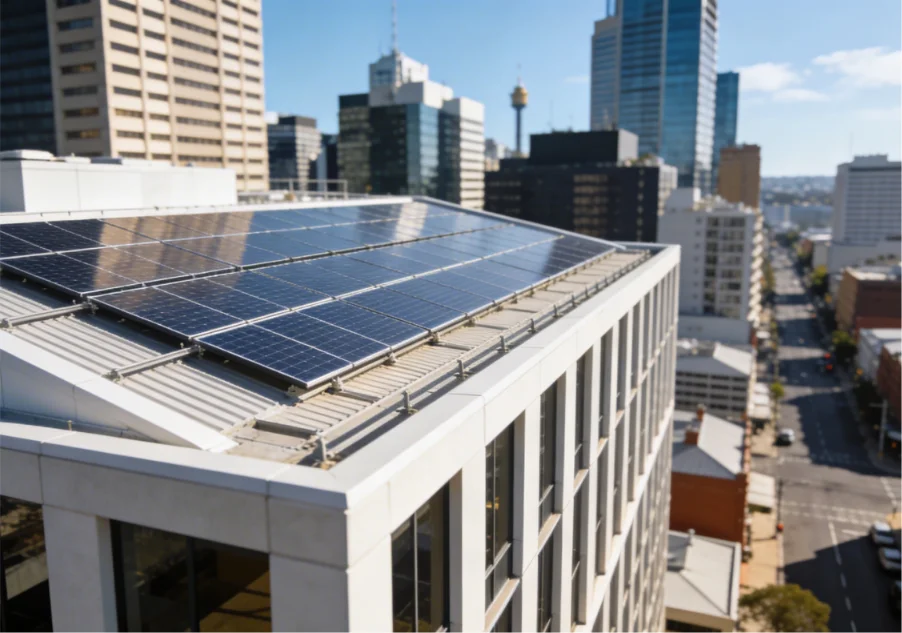
Commercial solar has traditionally been positioned as a sustainability initiative. It can support tenant expectations, improve environmental performance and contribute to broader ESG objectives.
While these benefits remain important, they overlook a significant part of the opportunity: the commercial value a rooftop energy system can create for the property owner.
As the regulatory, energy and rebate environment continues to change, the structure of a solar arrangement is becoming just as important as the system itself.
The structural issue with commercial solar
One of the longstanding challenges within commercial solar is the separation between the party funding the system and the party receiving the benefit.
When a landlord pays for a solar system under a traditional structure, the tenant generally benefits from lower electricity costs. Meanwhile, the landlord carries the capital expense, maintenance obligations and compliance considerations, often without receiving a direct financial return.
This imbalance has limited the appeal of solar as a genuine landlord investment.
Rethink Renewables’ managed model is designed to address this.
Under the managed model, the landlord owns and invests in the solar system, while Rethink Renewables manages the energy environment on their behalf. This includes metering, tenant billing, compliance and ongoing maintenance.
Tenants receive access to locally generated electricity at rates below comparable grid pricing, while the landlord participates in the income generated by the system. The rooftop becomes a productive property asset rather than an operating cost.
The sale of electricity in Australia requires an appropriate retail licence or exemption. Rethink Renewables holds the required authorisation to manage this process, allowing the model to operate within the applicable regulatory framework.
This differs from a traditional power purchase agreement, where the solar provider generally owns the system and retains the financial benefits associated with ownership. The tenant may receive lower electricity costs, but the landlord’s participation is often limited.

What is changing in FY27
Several developments are bringing greater urgency to the commercial solar conversation.
1. Solar rebates continue to reduce
The federal Small-scale Technology Certificate rebate reduces on 1 January each year and is scheduled to conclude in 2030.
As the rebate declines, the upfront support available for eligible solar installations also reduces. For a commercial system, delaying a project may result in a measurable difference in the rebate available.
The timing of approvals, installation and certificate eligibility should therefore form part of any commercial assessment.
2. Exporting solar is becoming less valuable
Export charges, sometimes referred to as the “sun tax”, are being introduced across a growing number of Australian electricity networks.
Historically, exporting surplus solar generation to the grid could provide an additional financial benefit. Increasingly, the strongest value is created when solar energy is consumed on site.
For commercial properties, this means system design matters. A system aligned with the tenant’s daytime energy usage may deliver a stronger result than an oversized system that relies heavily on exporting excess generation.
The focus is shifting from producing the greatest amount of electricity to using the greatest proportion of that electricity within the property.
3. Embedded network compliance is receiving greater attention
Changes applying from 1 July 2026 have introduced additional obligations for embedded network operators, including requirements relating to tariff transparency, customer price protections and access to dispute resolution.
For landlords with an existing embedded network, compliance should not be treated as an administrative detail. It is an important part of protecting the property owner, the tenant and the ongoing income generated by the energy arrangement.
A managed structure can help landlords navigate these obligations without taking responsibility for the day-to-day operation of the network.
Understanding the potential return
Commercial solar discussions have often focused on tenant savings and sustainability outcomes. For the landlord, an equally important consideration is the cash return generated by the asset.
Depending on the property, tenant energy profile, system design, funding structure and applicable tariffs, Rethink Renewables has identified managed solar opportunities with projected cash-on-cash returns in the range of 20 to 30 per cent after operator fees.
Every property must be assessed individually, and returns cannot be assumed. However, where the conditions are appropriate, a rooftop solar system may generate a stronger cash return per dollar invested than the underlying commercial property.
Ownership also determines who receives the associated depreciation and rebate benefits.
Under a traditional power purchase agreement, those benefits generally remain with the system provider. Under the managed model, they remain with the landlord as the asset owner.
Importantly, owning the asset does not require the landlord to operate it. The landlord can retain ownership, the potential tax benefits and the income stream, while Rethink Renewables manages the metering, billing, compliance and maintenance requirements.
Eligible systems may also be funded through commercial green finance, subject to lender approval and the landlord’s circumstances. This can provide an opportunity to establish the asset without committing the full project cost from existing capital.
Questions landlords should consider
Before entering any commercial solar or embedded network arrangement, landlords and their advisers should consider several important questions.
- Who will own the asset, both during and at the end of the agreement?
- Who receives the depreciation benefits and applicable rebates?
- What is the projected after-tax cash return on the capital invested?
- How much of the electricity generated will be consumed within the property, and how much is expected to be exported?
- What happens to the income if the existing tenant vacates?
- Can the agreement be transferred if the property is sold?
- Where an embedded network is already operating, does it meet the requirements applying from 1 July 2026?
These questions provide a clearer view of the commercial outcome and help distinguish between an arrangement that primarily reduces a tenant’s energy costs and one that also creates value for the property owner.
The broader investment opportunity
Solar can support tenant attraction, reduce emissions and contribute to a property’s ESG performance. These remain valuable outcomes.
However, they do not represent the full investment case.
When appropriately designed, owned and managed, a commercial rooftop energy system can create an additional income stream from an area of the property that may otherwise remain financially underutilised.
With rebates reducing, export pricing changing and embedded network obligations becoming more defined, FY27 presents an important opportunity for landlords to review the role their rooftop could play within the broader performance of their asset.
Rethink Renewables can complete an initial assessment using the property address and a recent tenant electricity bill. The assessment considers the potential system size, estimated tenant savings, projected landlord income under different ownership models and the rebate currently available.
This provides landlords with a clearer commercial picture before deciding whether to proceed.